- Amputation of digits
- Partial foot amputation (Chopart, Lisfranc)
- Ankle disarticulation (Syme, Pyrogoff)
- Below-knee amputation (transtibial)
- Knee-bearing amputation (knee disarticulation)
- Above knee amputation (transfemoral)
- Van-ness rotation/rotationplasty (Foot being turned around and reattached to allow the ankle joint to be used as a knee.)
- Hip disarticulation
- Hemipelvectomy
Sunday, August 31, 2008
Types of Leg Amputations
Eisenmenger's Syndrome
Description:
It is predominantly right-to-left shunt or reversal of left-to-right shunt, which usually resuts from severe pulmonary vascular obstruction.
Complications:1. Stroke
2. Hemoptysis
3. Hyperviscosity
4. Hemostatic abnormalities.
5. Thrombocytopenia
6. Prolonged bleeding, prothrombin or partial thromboplastin times.
7. Vitamin K-dependent clotting factors deficiencies.
8. Abnormal fibrinolysis.
9. Cholelithiasis
10. Hypertrophic osteoarthropathy
11. Hyperuricemia and goutrenal dysfunction.
12. Sudden death.
Clinical Features:
Symptoms : dyspnea on exertion, chest pain, syncope, hemoptysis, angina.
Signs : cyanosis (constant or exercise), ascites, pedal edema, clubbing.
Investigations:
1. Blood tests :
a) 100% O2 does not correct arterial desaturation.
b) polycythemia (Hb > 20 g/dl common)
2. Imaging studies : echocardiography, Doppler, hemogram, catheterization
ECG shows right ventricular hypertrophy changes.
Treatment:
Surgery is indicated if medical treatment does not improve the oxygen saturation levels.
Phlebotomy may be necessary.
Saturday, August 30, 2008
Acute otitis media
Causes:
1. Viruses - most commonly rhinovirus, RSV and coronavirus.
2. Bacteria - Streptococcus pneumoniae, Moraxella (Branhamella) catarrhalis, H. influenzae and Streptococcus pyogenes (rare).
Pathogenesis:
Eustachian tube is port of entry for middle-ear pathogens from nasopharynx, but also is primary route of clearing middle ear secretions. This causes inflammatory edema of nasopharynx. Following this exudative and transudative fluid collect in middle ear, which allows for overgrowth of nasopharyngeal bacteria in middle ear. This suppuration may lead to spontaneous rupture, usually anterior-inferior quadrant following which discharge is seen, which is initially serosanguineous and later becomes mucopurulent.
Complications:
1. Hearing loss
2. Mastoiditis
3. Meningitis
Clinical Features:
1. Redness with bulging of tympanic membrane.
2. Mobility may be impaired.
Treatment:
A: Medical
1. Analgesics (ibuprofen and acetaminophen)
2. Antibiotics (amoxicillin is drug of choice)
3. Decongestants and/or Antihistamines (not in children)
B: Surgical
1. Tympanostomy tubes reduce recurrences of otitis media when middle ear effusion present.
2. Myringotomy to drain the pus.
3. Adenoidectomy is not very effective.
1. Viruses - most commonly rhinovirus, RSV and coronavirus.
2. Bacteria - Streptococcus pneumoniae, Moraxella (Branhamella) catarrhalis, H. influenzae and Streptococcus pyogenes (rare).
Pathogenesis:
Eustachian tube is port of entry for middle-ear pathogens from nasopharynx, but also is primary route of clearing middle ear secretions. This causes inflammatory edema of nasopharynx. Following this exudative and transudative fluid collect in middle ear, which allows for overgrowth of nasopharyngeal bacteria in middle ear. This suppuration may lead to spontaneous rupture, usually anterior-inferior quadrant following which discharge is seen, which is initially serosanguineous and later becomes mucopurulent.
Complications:
1. Hearing loss
2. Mastoiditis
3. Meningitis
Clinical Features:
1. Redness with bulging of tympanic membrane.
2. Mobility may be impaired.
Treatment:
A: Medical
1. Analgesics (ibuprofen and acetaminophen)
2. Antibiotics (amoxicillin is drug of choice)
3. Decongestants and/or Antihistamines (not in children)
B: Surgical
1. Tympanostomy tubes reduce recurrences of otitis media when middle ear effusion present.
2. Myringotomy to drain the pus.
3. Adenoidectomy is not very effective.
Thursday, August 28, 2008
Astigmatism
Definition:
It is the condition in which an optical system has different foci for rays that propagate in two perpendicular planes. If an optical system with astigmatism is used to form an image of a cross, the vertical and horizontal lines will be in sharp focus at two different distances.
Types:
A: Based on axis of the principal meridians
1. Regular
- With the rule
- Against the rule
- Oblique
- Bioblique
2. Irregular
B. Based on focus of the principal meridians
1. Simple
- Myopic
- Hypermetropic
2. Compund
- Myopic
- Hypermetropic
3. Mixed
Symptoms:
1. Blurring of vision
2. Squinting
3. Asthenopic symptoms
4. Headache
Treatment:
Astigmatism may be corrected with eyeglasses, contact lenses, or refractive surgery.
Spherical lenses correction along with a cylindrical lens for correction of the residual error is used.
It is the condition in which an optical system has different foci for rays that propagate in two perpendicular planes. If an optical system with astigmatism is used to form an image of a cross, the vertical and horizontal lines will be in sharp focus at two different distances.
Types:
A: Based on axis of the principal meridians
1. Regular
- With the rule
- Against the rule
- Oblique
- Bioblique
2. Irregular
B. Based on focus of the principal meridians
1. Simple
- Myopic
- Hypermetropic
2. Compund
- Myopic
- Hypermetropic
3. Mixed
Symptoms:
1. Blurring of vision
2. Squinting
3. Asthenopic symptoms
4. Headache
Treatment:
Astigmatism may be corrected with eyeglasses, contact lenses, or refractive surgery.
Spherical lenses correction along with a cylindrical lens for correction of the residual error is used.
Wednesday, August 27, 2008
Myopia
Definition:
It is that dioptric condition of the eye in which parallel rays of light are brought to focus at a point in front of the retina, in an eye with accomodation at rest.
 Classification (based on etiology):
1. Axial myopia
2. Refractive myopia
It is that dioptric condition of the eye in which parallel rays of light are brought to focus at a point in front of the retina, in an eye with accomodation at rest.
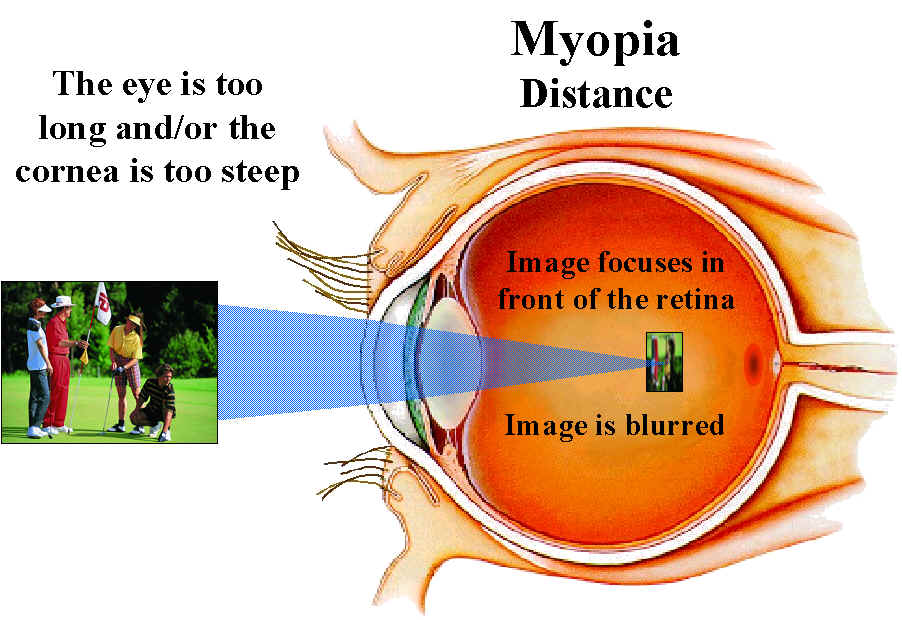 Classification (based on etiology):
1. Axial myopia
2. Refractive myopia
- Curvature myopia
- Index myopia
Treatment:
- Eyeglasses
- Contact Lenses
- Refractive Surgery
Subscribe to:
Posts (Atom)