Saturday, December 8, 2007

Bronchiectasis

Inrtoduction:

Bronchiectasis is a disease that causes localized, irreversible dilatation of part of the bronchial tree. Involved bronchi are dilated, inflamed, and easily collapsible, resulting in airflow obstruction and impaired clearance of secretions. Bronchiectasis is associated with a wide range of disorders, but it usually results from necrotizing bacterial infections, such as infections caused by the Staphylococcus or Klebsiella species or Bordetella pertussis.

Pathogenesis:
Dilation of the bronchial walls results in airflow obstruction and impaired clearance of secretions because the dilated areas disrupt normal air pressure in the bronchial tubes, causing sputum to pool inside the dilated areas instead of being pushed upward. The pooled sputum provides an environment conducive to the growth of infectious pathogens, and these areas of the lungs are thus very vulnerable to infection. The more infections that the lungs experience, the more damaged the lung tissue and alveoli become. When this happens, the bronchial tubes become more inelastic and dilated, creating a self-perpetuating cycle of further damage to the lungs.

Causes:
There are both congenital and acquired causes of bronchiectasis. Kartagener syndrome, which affects the mobility of cilia in the lungs, aids in the development of the disease. Another common genetic cause is cystic fibrosis, in which a small number of patients develop severe localized bronchiectasis. Young's syndrome, which is clinically similar to cystic fibrosis, is thought to significantly contribute to the development of bronchiectasis. This is due to the occurrence of chronic, sinopulmonary infections. Patients with alpha 1-antitrypsin deficiency have been found to be particularly susceptible to bronchiectasis, for unknown reasons. Other less-common congenital causes include primary immunodeficiencies, due to the weakened or nonexistent immune system response to severe, recurrent infections that commonly affect the lung.

Treatment:
Treatment of bronchiectasis is aimed at controlling infections and bronchial secretions, relieving airway obstruction, and preventing complications. This includes the prolonged usage of antibiotics to prevent detrimental infections, as well as eliminating accumulated fluid with postural drainage and chest physiotherapy. Surgery may also be used to treat localized bronchiectasis, removing obstructions that could cause progression of the disease.
Inhaled steroid therapy that is consistently adhered to can reduce sputum production and decrease airway constriction over a period of time, and help prevent progression of bronchiectasis. One commonly used therapy is beclometasone dipropionate, which also used in asthma treatment. Use of inhalers such as albuterol (salbutamol), fluticasone (Flovent/Flixotide) and ipratropium (Atrovent) may help reduce likelihood of infection by clearing the airways and decreasing inflammation.

Thursday, December 6, 2007

Mesothelioma

Mesothelioma is a form of cancer that is almost always caused by previous exposure to asbestos. In this disease, malignant cells develop in the mesothelium, a protective lining that covers most of the body's internal organs. Its most common site is the pleura (outer lining of the lungs and chest cavity), but it may also occur in the peritoneum (the lining of the abdominal cavity) or the pericardium (a sac that surrounds the heart).

Most people who develop mesothelioma have worked on jobs where they inhaled asbestos particles, or have been exposed to asbestos dust and fibre in other ways, such as by washing the clothes of a family member who worked with asbestos, or by home renovation using asbestos cement products. Unlike lung cancer, there is no association between mesothelioma and smoking.

Source : Wikipedia

Wednesday, December 5, 2007

Bubonic Plague


Source:Wikipedia

Tuesday, December 4, 2007

Meckel's diverticulum

Introduction:
A Meckel's diverticulum, a true congenital diverticulum, is a small bulge in the small intestine present at birth. It is a vestigial remnant of the omphalomesenteric duct (also called the vitelline duct), and is the most frequent malformation of the gastrointestinal tract. It is present in approximately 2% of the population, with males more frequently experiencing symptoms.

Symptoms:
If symptoms do occur, they typically appear before the age of two.
The most common presenting symptom is painless rectal bleeding, followed by intestinal obstruction, volvulus and intussusception. Occasionally, Meckel's diverticulitis may present with all the features of acute appendicitis. Also, severe pain in the upper abdomen is experienced by the patient along with bloating of the stomach region. At times, the symptoms are so painful such that they may cause sleepless nights with extreme pain in the abdominal area.

Treatment:
Treatment is surgical, consisting of a resection of the affected portion of the bowel.

Whipple's disease

Introduction:
Whipple's disease is a rare, systemic infectious disease caused by the bacterium Tropheryma whipplei. First described by George Hoyt Whipple in 1907 and commonly considered a gastrointestinal disorder, Whipple's disease primarily causes malabsorption but may affect any part of the body including the heart, lungs, brain, joints, and eyes. Weight loss, diarrhea, joint pain, and arthritis are common presenting symptoms, but the presentation can be highly variable.


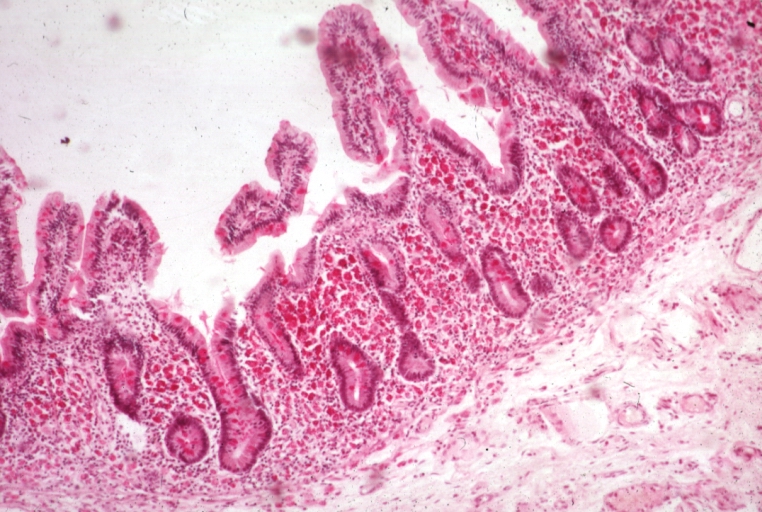
This micrograph shows the typical findings of enlarged villus with abundant macrophages in the in small intestine.


Symptoms:
  • Arthritis or arthralgia
  • malabsorption
  • intestinal lipodystrophy (accumulation of fatty deposits in lymph nodes of the intestine)
  • lymphadenopathy
  • abdominal pain
  • diarrhea
  • fever
  • melanoderma
  • Neurological symptoms

Treatment:

Treatment is with penicillin, ampicillin, tetracycline or co-trimoxazole for 1 -2 years.